
Anderson Criminal History Checks
No single city screen holds every Anderson record. The Anderson Police Department is the first stop for its incident, arrest, accident, local-check, and citation material. Municipal Court is the source for a city case that it hears. The Anderson Public Index can supply participating court docket facts, while county detention and court systems cover records that have moved beyond city custody or city jurisdiction. SLED CATCH is a separate South Carolina repository report.
Follow the event, not just the name. A police report describes the initial allegation. A booking entry records a custody event. A municipal or county docket shows what charge was filed and how the court handled it. A name match alone does not prove identity, and an Anderson Police local check does not equal a statewide report.
- Ask Anderson Police Records for the city report, arrest record, or local record check that fits the need.
- Check the APD detention roster and the Anderson County roster when current custody is the question.
- Contact Anderson Municipal Court for a city case, especially when it is absent from Public Index.
- Use Anderson County court and booking channels if the case or custody moved to the county level.
- Use SLED CATCH only when a South Carolina repository history is needed, and keep its limits in mind.
Anderson Police Local Record Check
Anderson Police offers an APD-only local record check for $5. A person requesting their own Anderson check presents photo identification. A request for another person's check requires that person's signed consent. The product concerns Anderson Police records. It is not SLED CATCH, does not stand for all Anderson County agencies, and should not be described as a full state history.
That distinction matters for self-review. Someone who lived in the city may find an APD incident or arrest record that is not the same as a final court result. Conversely, the local check does not pull every South Carolina fingerprint-supported record. Compare the police result with the court file when an Anderson event led to charges. Use SLED only when the wider state repository view is the actual question.
| Anderson Police service | Published amount | Key condition |
|---|---|---|
| APD local record check | $5 | Photo ID for own check; signed consent for another person. |
| Victim incident copy | Free | Requester is the victim tied to the report. |
| Other incident copy | $8.50 | Release and redaction rules still apply. |
| Involved-party accident copy | Free | Requester is an involved party. |
| Other accident copy | $8.50 | Copy is requested by someone else. |
| Fingerprint cards | $10 | Card service is distinct from the local check. |
Records at the Anderson Police Department
The Anderson Police Department works from 401 South Main Street, Anderson, South Carolina 29624. Its Records Division keeps incident, accident, and arrest reports, prepares criminal statistics and local checks, and supports citation and arrest processing. Records hours are Monday through Friday, 8:30 a.m. to 5 p.m. General information is 864-231-2272, while the published booking-status line is 864-231-2277.
Give Anderson Records enough facts to find the right file: the type of event, a date range, names, and a report or citation number when known. The division may need to redact protected information before release. An incident report records what was alleged and what officers documented. It is not proof that a court found guilt. If a request seeks the court outcome, move to the court clerk rather than asking police to certify a result they do not control.
Anderson Police Records
401 South Main Street
Anderson, SC 29624
864-231-2272
Monday-Friday, 8:30 a.m.-5 p.m.
Anderson Report Copies and Fees
Anderson separates report-copy fees by the requester's link to the event. Victims receive their incident copies without a copy charge, while other requesters pay the published $8.50 rate. An involved party receives an accident copy free; another requester pays $8.50. These rates answer the copy question, not whether every part of the record is public. Protected victim, juvenile, and active-investigation facts can still be withheld or redacted.
For a focused Anderson request, identify the report class before contacting the counter. Ask for an incident report if the need is the police narrative. Ask for an arrest record if the concern is the custody action. Seek the docket and disposition from the court when the issue is prosecution. One broad request for all criminal history can cause delay because Anderson Police does not maintain the court's final case file or SLED's statewide repository.
Note: A copy fee buys the releasable record; it does not turn exempt or protected material into a public field.
Booking and Arrest Records in Anderson
An Anderson Police arrest may first appear in the city detention system, not in the Anderson County jail roster. APD has a separate public roster. Search both custody systems after a city arrest, because the two lists answer different operational questions. The APD roster reflects city detention. The county Zuercher portal reflects current or recent custody handled by the Anderson County Detention Center. A transfer can change where a person appears.
Use the booking-status number when a recent Anderson arrest is not visible online. Timing, release, transfer, a spelling variation, or the roster's scope can explain a missing name. Do not assume that no arrest occurred simply because the county list has no result. Likewise, do not read a roster charge as a conviction. The filed charge and disposition come from the court record and may differ from the intake label.
The official Anderson Police detention roster is the city-specific custody source.
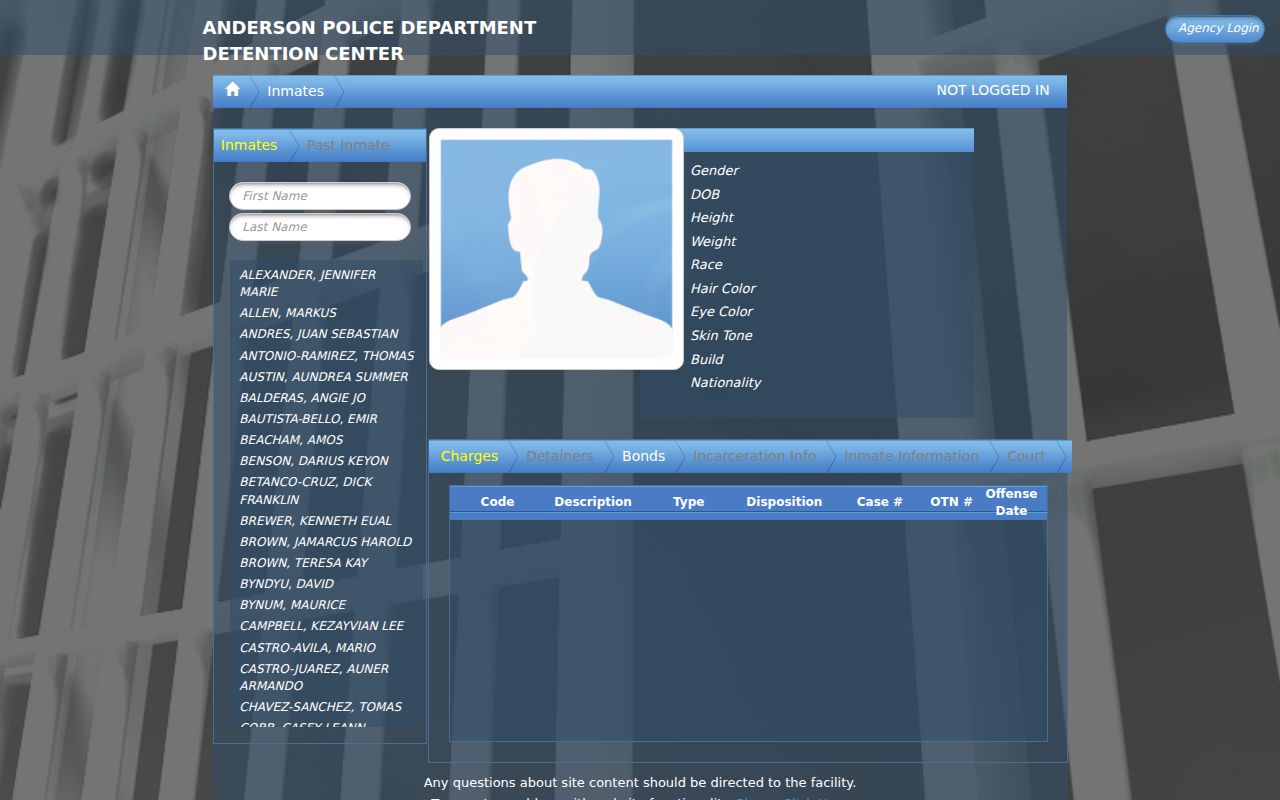
The roster screen shows why an Anderson city booking check must remain separate from the county detention search.
Anderson City and County Rosters
The APD and ACSO rosters should not be treated as duplicates. Anderson Police can hold and list a city arrestee, while the county detention portal covers people booked into county custody. If Anderson Police transfers a person, the city entry and county entry can appear at different times. Booking status at 864-231-2277 is the direct city fallback. County custody questions belong to the Anderson County Detention Center.
For a recent arrest, search the APD roster first when Anderson Police made the arrest, then search the county roster. If both are blank, call the city booking line and verify spelling and date. Next, check the court channel for a warrant or newly created case. The broader Anderson County Arrest Search explains county records, agency requests, and the detention route without turning the city page into a county overview.
The Anderson Municipal Court File
Anderson Municipal Court handles matters brought by City Police, Building and Codes, and Fire within its jurisdiction. It operates in the 401 Main Street and South Main complex and holds sessions four days each week. Judges are available around the clock for city arrest and search warrants. Call 864-231-2271 for the court; the published fax is 864-260-1069.
Use the Anderson Public Index when the municipal matter appears there. Participating municipal data is not guaranteed to include every city file, so direct clerk contact is the required fallback. The court file, not the APD roster, is where a reader looks for the filed charge, plea, hearing events, disposition, sentence, and costs. A city police report and a municipal docket may describe the same event from different record stages.
| Court Name | Anderson Municipal Court. |
|---|---|
| Case Sources | City Police, Building and Codes, and Fire matters within city jurisdiction. |
| Case Lookup | Anderson Public Index when included; otherwise direct contact with the municipal clerk. |
| Docket Contents | Case number, filed charge, events, plea, outcome, sentence, and financial entries where recorded. |
| Sessions | Four days weekly; confirm the live calendar before a visit. |
| Contact | 864-231-2271; fax 864-260-1069. |
Missing Anderson Municipal Case
A missing Anderson municipal case does not mean there is no case. First, confirm the name, date range, and case type used in Public Index. Municipal participation and data coverage can differ. Cookies and JavaScript must be enabled, and pop-ups may be needed for details. If the city case still does not appear, call Anderson Municipal Court and ask the clerk to search its local file.
The matter may also have moved beyond municipal jurisdiction. More serious charges proceed through Anderson County's Court of General Sessions, while summary matters can stay with a municipal or magistrate court. Ask which court now has the case number. The county Court Case Lookup covers the Public Index and General Sessions path in depth. City Police cannot provide a certified court disposition just because its report began the record trail.
How Anderson Records Reach the County
Anderson Police creates the first incident or arrest record. A city detention entry can follow. Municipal Court holds qualifying city cases, while charges outside city-court jurisdiction move into county prosecution and General Sessions. Court officials then report dispositions for the statewide criminal-history system. Each stage can use a different charge label, date, and record number, which is why one screen cannot supply the whole history.
Record flow: Anderson Police Department › Anderson Municipal Court or Anderson County Courts › South Carolina Law Enforcement Division.
Recent activity is usually clearest at its source. For an Anderson event, ask APD for the report and check the relevant custody list. For the legal outcome, identify the court that took the charge. Use SLED CATCH later for the South Carolina repository view, but remember that its name match can differ from the source file and does not replace a certified disposition.
Anderson LIVESCAN Reaches SLED
Anderson Police uses LIVESCAN during booking to check fingerprint quality, send prints electronically to SLED, receive a state identification response when prior prints exist, and connect the result with the jail system. Archived prints can support later reprints. This path helps explain why fingerprint-supported state history is more reliable for identity than a name alone.
The transmission does not make every APD field public. A booking record still describes the arrest stage. SLED builds the statewide cycle from fingerprint-supported arrest data and later judicial dispositions. If an Anderson court outcome has not yet linked to the arrest, the APD file, docket, and CATCH report may temporarily disagree. A self-audit should compare those three custodians and direct any correction to the office that owns the wrong field.
Anderson Body-Camera Records Differ
Anderson's city policy states that body-worn camera video is not a public record subject to ordinary South Carolina FOIA access. That makes it different from a routine releasable incident-report copy. Do not assume payment of the city's media or labor charge creates access to footage that the law or policy keeps outside public disclosure.
Other Anderson records may still be requested under the city process. The published FOIA schedule lists $20 per hour for staff time, 50 cents per page, $5 for a CD or DVD, $15 for a 2GB USB drive, plus actual postage or media. A 25 percent deposit may apply. Electronic delivery can avoid page-copy cost, but it does not erase conversion, search, or redaction labor. Narrow requests by report type, date, and incident number to reduce work.
Anderson Record Access Rules
South Carolina FOIA governs ordinary public access to Anderson city records, but public does not mean unredacted. Police may withhold material protected by a statutory exemption, including sensitive law-enforcement details, victim or minor information, and data whose release would harm an active investigation. Municipal court records follow judicial access rules, and sealed or expunged matters do not belong in the ordinary public channel.
Ask the right Anderson custodian for a defined record. APD answers for its report and city booking material. Municipal Court answers for its docket and certified copies. The Anderson County clerk handles General Sessions records. SLED maintains the statewide criminal-history repository. If an office denies all or part of a request, ask for the legal basis and consider narrowing the scope.
Key Statutes:
S.C. Code §30-4-30 permits inspection and copying of public records, subject to reasonable actual-cost fees and the law's response rules.
S.C. Code §30-4-40 allows specified law-enforcement, privacy, and other exempt material to be withheld.
S.C. Code §23-3-120 requires covered arrest fingerprints and criminal data to flow to SLED's central repository.